
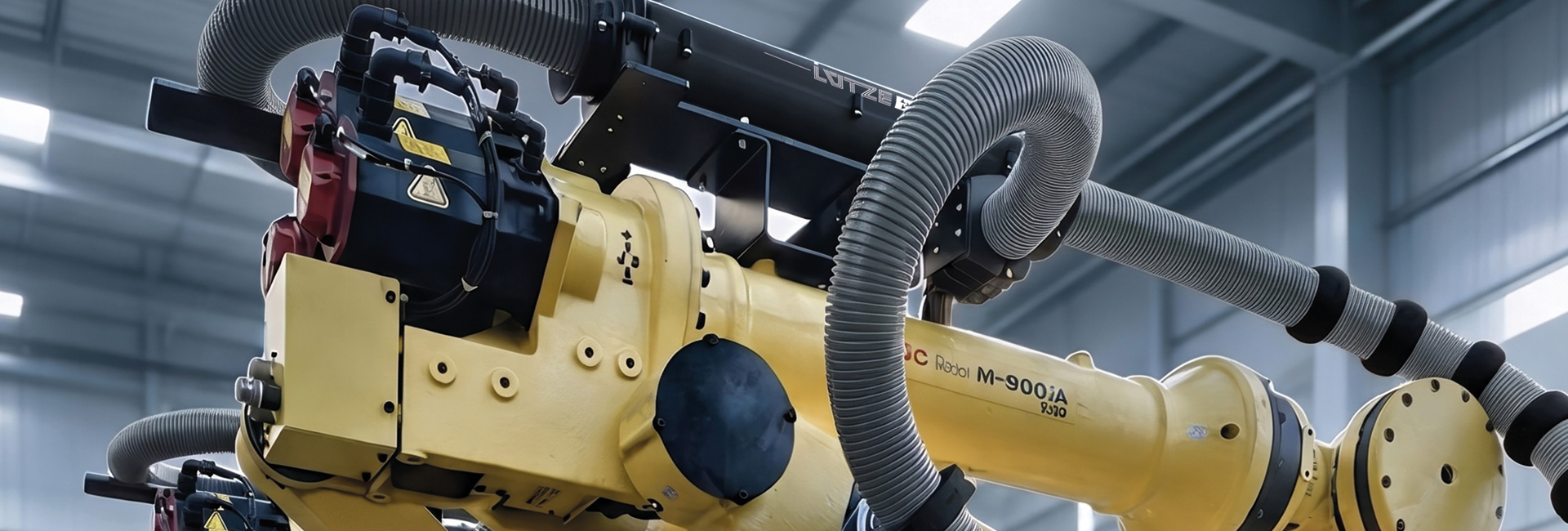
Dresspacks
Robot Dresspacks for Your Robot Cell
A dresspack must follow the robot through its entire motion space without loading the cables beyond their permissible bending and torsion limits.
We engineer robot dresspacks based on robot type, tool, media and motion sequence and supply them as components, an empty conduit package or a fully populated dresspack - documented for cell planning and reordering.
When You Should Contact Us
New robot cell
Tool and process are defined. The package must match the cell, tool and robot program.
Tool or process change
The new tool requires additional media, larger conductor sizes or different connectors.
Retraction system
A retraction system controls the length reserve of the package when the robot does not need it - usually using a spring. It compensates for the length difference between extended and bent arm positions and reduces loop formation. Whether it is needed depends on the application; it is usually mounted on the upper arm.
Unusual wear
If a package fails repeatedly, we begin with a damage assessment.
Go to Repair & Service
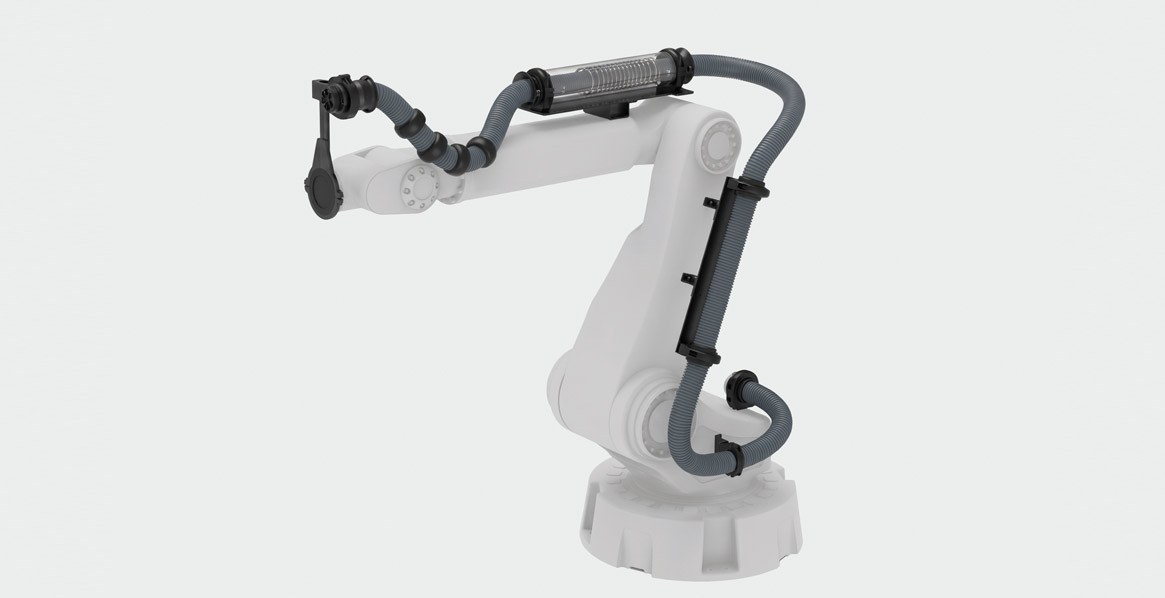
Three Delivery Levels
You decide how far the package is prepared before delivery - from individual components to the fully populated dresspack. We record the agreed scope in the configuration documentation.
| Components | Empty Conduit Package | Fully Populated Dresspack | |
| Description | Individual components matched to the robot type and application - for machine builders and integrators who assemble packages themselves or supplement an existing system.
| Preassembled mechanical system consisting of corrugated conduit, brackets, mounting hardware and - depending on the application - a retraction system, without cable/hose contents. You install the cables and hoses to your own standard. | With installed cables and media hoses according to your media list; on request ready to connect with connectors at the disconnect points and the agreed inspections. |
| Corrugated conduit, brackets, ball joints, mounting hardware | individual | ✓ | ✓ |
| Retraction system | individual | depending on application | depending on application |
| Preassembled as a package | - | ✓ | ✓ |
| Installed cables and media hoses | - | - | ✓ |
| Connectors and connections at disconnect points | - | - | as agreed |
| Identification and documentation | per item | ✓ | ✓ |
What a Robot Dresspack Consists Of
Cable and hose bundle
Power, servo, control, bus and sensor cables plus media hoses for compressed air, vacuum or cooling water. Conductor sizes, outside diameters and bending behavior determine the corrugated conduit size and the movement behavior of the package.
Corrugated conduit
The corrugated plastic conduit protects the cable and hose bundle from abrasion, metal chips and welding spatter. The nominal size (NW) indicates the conduit size. The actual inside diameter, contents and required movement reserve matter for the design: if the conduit is too tight, friction and heat increase; if it is too large, the cables move uncontrollably inside.
Retraction system
A retraction system controls the length reserve of the package when the robot does not need it - usually using a spring. It compensates for the length difference between extended and bent arm positions and reduces loop formation. Whether it is needed depends on the application; it is usually mounted on the upper arm.
Brackets and ball joints
Brackets secure the package at defined points on the robot structure. Ball joints, especially at the tool-side end, allow rotary motion and prevent stress in the corrugated conduit.
Strain relief
Strain reliefs absorb tensile forces at defined attachment points and protect connected cables, connectors and fittings from impermissible loads.
Disconnect points
Connectors and couplings at the base, upper arm or tool. Well-positioned disconnect points allow only one section to be replaced after damage, such as the wrist-axis area.
Torsion explained briefly
Torsion is the twisting of a cable around its longitudinal axis, as occurs during rotary and swiveling movements of the wrist axes. It is specified in degrees per meter (deg/m). Not every C-track cable is suitable for the torsion on a robot arm - which is why we select cables based on the motion in your application.
How We Engineer Your Dresspack
1. Task and media list
Which cables and hoses does the tool require - with which conductor sizes, pressures and connectors?
2. Robot and motion
Robot type, mounting orientation, motion space and end positions as well as motion sequence, speed, acceleration and cycle rate determine lengths, routing and loads.
3. Concept
Routing along the axes, nominal conduit size and the position of brackets, retraction system and disconnect points.
4. Coordination and documentation
We coordinate the concept with you and document it with a bill of materials and identification.
5. Manufacturing and handoff
The package is manufactured to the approved configuration and delivered with the agreed documentation.
This Information Helps Us
- Robot manufacturer, robot type and mounting orientation (floor, ceiling, wall)
- Media list: cables with conductor count and cross-section, bus or Ethernet type, hoses with diameter, medium and pressure
- Motion sequence: program, simulation data or a description of end positions, speed and cycle rate
- Quantity and required date
- Tool or process, for example handling, welding, gluing or fastening
- Connectors and transfer points at the base, upper arm and tool
- Environment: welding spatter, metal chips, oil, coolant, temperature
- For retrofits: identification and bill of materials of the existing package
Robots from Different Manufacturers and Existing Systems
We engineer dresspacks for the specific robot type - for new cells as well as existing systems. The basis is the model's mounting points, motion space and interfaces together with your available documentation.
Frequently Asked Questions
Externally routed or routed inside the robot arm?
That depends on the robot model and application. With a hollow upper arm or hollow wrist, internal routing may be possible. It reduces interference contours but limits the space available for cables and hoses. Externally routed packages provide more space and are easier to access. We evaluate both options for your application.
How long does a robot dresspack last?
It depends on motion sequence, cycle time, cable/hose contents, routing and environment. A general service-life figure would not be reliable. The greatest controllable influence is a sound design with suitable cables, retraction and disconnect points.
Do I always need a retraction system?
No. If the length change is small, fixed routing is often sufficient. For large wrist-axis movements, a retraction system controls the length reserve. We decide based on the motion space and motion sequence of your program.
Can an existing dresspack be modified?
Yes, if the requirements have changed - for example due to a new tool, different media, modified motion sequences or recurring wear points. We show you which changes make technical sense.
Discuss your dresspack with us
Tell us the robot, tool and media. Basic information is enough; we clarify the details with you.
* Indicates required field.